CLASSIC GAMING
MYST
Developer - Cyan Inc.
Publisher - Broderbund Software
Genre - Point-and-click Adventure/Puzzle
Year - 1993
System - Macintosh/PC/Sega Saturn/PlayStation/Jaguar/Amiga/CD-i/3DO
(The island almost looks like a failed SimIsle creation)
It has been a goal among most videogame companies to make a videogame that becomes enough of an experience for the player to become really involved with. An experience into a world that while entirely made of polygons and pixels feels so real that you can't help but fall into. Everyone has their game that they get lost in. How many of them can say that one of those games is MYST is another matter.
(I wonder if this book's rated by Amazon.com?)
Story - The story is never offered all at once, given to you snip by snip as you gradually go through the game. You play as a human known only as "The Stranger", who finds a mysterious old book entitled MYST and upon opening it, there is a moving picture of an island. With no choice left to you, you are sucked into the book's island world where you must explore and discover your way around the place.
The island itself holds a potholed history from many burnt books about a family who lived on the island but soon encountered some terrible events caused by their own two sons, who are now imprisoned within two separate books on the island, as well as 5 other worlds linked to the island (which in the game are called Ages). Each of them plead to you to find the missing pages torn from their literary prisons and restore them to being, pleading that they do not release the other imprisoned son, a choice given before you of who to unlock.
While at first this game looks simple enough, there is a hidden undercurrent of conspiracy within this family that if you're observant enough will be able to fully reveal and find the real truth. And the truth is hard to find for each son has their bad points, as you can clearly see from the decor of their residences throughout the world of MYST.
("Here's where yer get off, Stranger...")
Gameplay - The game's control is incredibly easy so you have no worries there. You navigate by a small hand-like pointer with your mouse, going left or right by clicking the sides of the screen and clicking the middle of the screen to go forwards. Your "hand" can also interact with objects by clicking on them or holding down your mouse button. While exploring, you may find the pages of the books the two sons are trapped in. You can only carry ONE page at a time. You can even go back to the world again and get the other page back but eventually you have to finish either book to release the imprisoned son, whichever one you choose.
(It is now 12:00pm, MMT = Myst Mean Time)
Graphics - The graphics are beautifully painted shots of a fictional world that while seems incredibly lifeless, feels just as inspiring and deep as any world can be in terms of natural beauty and man-made enlightenment. The game is very static however, as in every spot you stand there are only as much as four screenshots to see, with very little actually moving, as if you really are walking through a painting, which is lovely. But sometimes you want to see the painting move. They are impressive for 1993, especially when you start encountering people in the game, one of the first pieces of motion acting in videogames.
(If you go down to Channelwood today, you're gonna get a surprise)
Music/Sound - Robyn Miller, one of the two Miller brothers who designed MYST originally, is a masterful musician with quite grand-sounding music you expect from a tiny orchestral club. While slightly tinny due to its early making, it is impressive to listen to for its very force in its time. The music is very classically based and every world had their own feel depending on the habitat itself. The Stoneship Age, a single sunken ship at a huge rock was very fleeting and airy with the sea and sky. In contrast, the Mechanical Age, a fortress of gears, had more pounding percussion owing to its man-made feel.
(One of the most surreal areas of MYST that show off the Miller Bros. imagination)
The sound is just as elemental as the music. There is absolutely no area of the game that is without it. From the gentle humming of a strange machine, to the whooshing howling winds of underground passages, to the forest animal sounds of the Channelwood Age, a world full of dizzyingly tall trees on a serene lake. The sound itself makes up for the graphic's static clinical barrier of a lifeless world by imbuing a much more refreshing breath into the place with its natural effects. This was not always the case though. The game was originally made and released on Macintosh computers, and when the 1994 Windows version came around, quite a few problems emerged, such as the lack of fading sound effects when leaving an area. But the Masterpiece Edition released in 2000 and published by UbiSoft cleaned up quite a few bugs for a smoother experience.
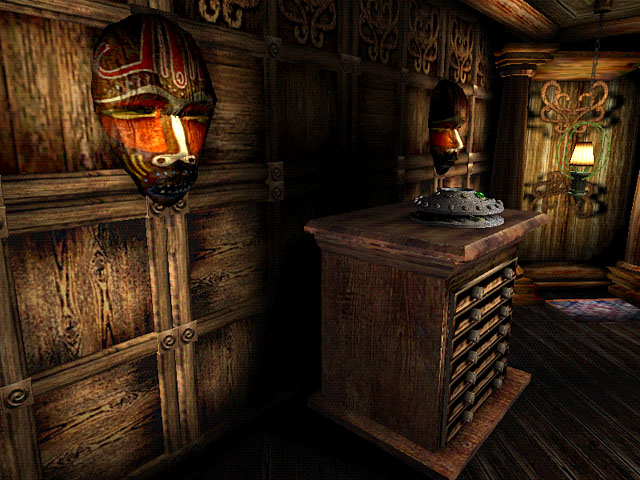
(Even MYST has its darker sides...)
This is the game that sold over 6 million copies and became the best selling computer game throughout the 1990's before The Sims took that title from it. Not only has it spawned four sequels of the continuing saga of The Stranger, but also two remakes of the original game (the Masterpiece Edition, RealMYST which was a full 3D experience of the original game with full atmospheric effects, and a
PSP remake made recently with help from SEGA) and three novels. This is a game that has become a trendsetter of videogames for being the first game to have the adventure/puzzle in first person for a more personal feeling experience for the player.
Rand and Robyn Miller's company Cyan Inc. have become one of the finest things ever to come out of Spokane, Washington for this game alone. It is an intrinsic experience no matter what version of the game you have, as well as being the first step in a long going series of games that has now ended on its fifth chapter. Even though the ending has now been written, it doesn't stop people from reopening that book again and reading it right from the very beginning, like all good books deserve to be.
Final's Final Rating - 7/10"Videogames are bad for you? That's what they said about rock 'n' roll." - Shigeru Miyamoto
 Hail Slither, The Eternal Champion!