CLASSIC GAMING
Comix ZoneDeveloper - SEGA Technical Institute
Publisher - SEGA
Genre - Sidescrolling Beat-em Up
Year - 1992
System - Sega Genesis Mega Drive
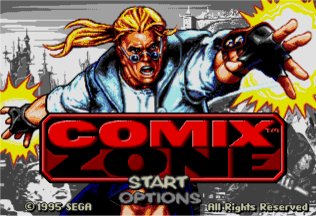
(To quote He-Man: "I HAAVE THE POOOWWWEEEERRRR!")
There have been moments when a game has come out and manages to blow away the group of people who had their eyes caught on it. Usually it's the graphics that draw someone into a game, like the old saying in cooking goes. "The first taste is with the eye." Whether the graphics be the gothical awe of Devil May Cry, the realistic starkness of Half Life 2's dystopian world or even the strange shading of Killer 7, it is always good to show that the game is different by what the graphics can do.
Comix Zone is one of those diamonds in the rough of videogame history in graphical terms, and one of the games that marked a time when SEGA were really on a roll with their originality and creativity.
Story - The story is somewhat simple and relevant to its setting. A comic book artist known as Sketch Turner is working on his comics in a New York apartment, when a strange bolt of lightning hits too near his window and causes something in his comic to come alive. From his comic bursts forth the villain of the comic and the game itself, Mortis, who wishes to be free and conquer the world as flesh instead of mere paper. But the only way to become flesh, is to kill his creator, Sketch. So he sends Sketch into his own comic and attempts to destroy him within his own world as a twisted form of irony. Because villains love irony and its part of their daily world-conquering breakfast plans.
The objective of the game is for Sketch to battle through his own comic and escape back to his apartment to defeat his own dark creation.

(At this point, Sketch should be called Frankensketch.)
- The first thing you will notice of the game is that it presents itself exactly like a comic book, complete with panels you progress through, paper pieces torn within the world, and also the yellow exclamations of MEANWHILE and so forth. The levels are very linear, exactly as a comic should be, with you moving from level to level by means of jumping over the edges of the comic panels, after you of course complete that panelled section, which usually ranges from beating up all the villains to solving a little puzzle.
Not only that, but Sketch himself has his own skills even if he is a comic artist. He's a bit of a kung fu artist and you can utilise a few combos of punches and kicks to deter your enemies and blow them away, as well as a particular special attack you can choose to have from the Options menu at the title screen, but which sacrifices some of your health to do so. There are also powerups ranging from the health drink to recover your energy (shown as a green bar below your inventory which can only hold up to 3 items) to weapons like that of a knife or dynamite or even the Power Slam (a fist-shaped powerup that tears a shockwave through the whole comic and obliterates any enemies present.)
(Ready? One...two...three...DRAW!)
Sketch also has his ally and trusted pet, Roadkill the rat. Not only is he quite clever at turning switches on and off but he can sometimes be able to find a hidden powerup hidden inside the paper world. Even if you aren't a fan of comics, this is definitely a game that you should give some respect for at least trying to move away from original formats of sidescrolling beat-em ups like Streets of Rage or Final Fight.
You can even be able to rip out pieces of paper from the background and throw paper planes at enemies, but this uses up some of your health since you're part of the comic paper itself.
Graphics - The graphics show some of the most best 2D graphics you may have seen, and certainly some of the best for its year. Because the levels are comic pages, the graphics mimic the styles of comics you've probably known from Stan Lee, Bob Kane or Alan Moore, since they were actually drawn by real comic artists. They are a familiar style to almost everyone and that familiarity is what makes it quite easy for you to adjust to the new graphical form. Not only do you get the usual background art of strange barren landscapes from ruined cities to dry wastelands, but also the 2D is utilised to its very best by trying to extend its parameters, such as the destroying of the side panels of the comic strip in a flurry of almost 3D-looking paper shards or seeing your villain's hand drawing in another villain for you to fight against, as well as the fact that every single punch and kick you deliver gives out a visual KRAKK or POW without fail.
(The alien was repulsed at the crotch split in Sketch's trousers)
- All of the music in the game is played by an in-house rock band of SEGA's technical Institute, called Roadkill (whom Sketch's rat is named after) and it accompanies the game's format nicely. Synthesised rock-style music is played throughout the game by band leader Howard Drossin and makes a nice feel for not only the scenery present before you, but also when you're kicking some ink-and-graphite ass. The sound effects are almost comical in their exaggerations as with the KRAKK and POW words following them, which merely adds to the entire FEEL of the comic world itself, giving off the exact overdramatic sense of comic books in their visual format. The only difference is that someone else has made the sounds for you instead of you making them up in your head or you shouting "KRAKK! POW!!!" and so forth.
Comix Zone is a game that seems to have been forgotten, especially by the arrival of such games as Viewtiful Joe and Killer 7, which also utilise the idea of the comic strip for a videogame. This was a game back when SEGA were good and actually imaginative, before of course they succumbed under terrible finance and had to go under Nintendo to stay around. It was one of the great jewels in SEGA's lineup of the early 90's, and it should be mentioned, whether or not you even like SEGA. At least they tried something different.
Final's Final Rating - 7/10"Videogames are bad for you? That's what they said about rock 'n' roll." - Shigeru Miyamoto
 Hail Slither, The Eternal Champion!